Gender equality in J&K had to wait till Articles 370 & 35A were abrogated
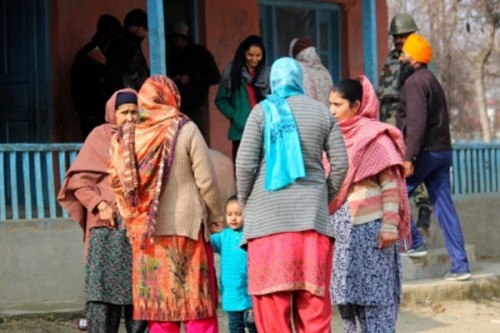
Srinagar, March 13 (IANS) Whether or not the discrimination against women in terms of property ownership and other rights was intended or inadvertent in Jammu and Kashmir (J&K) till Article 370 remained in force, the irrefutable fact is that gender discrimination was evident and encouraged.
Before Article 370 and Article 35A were abrogated by the Parliament of India on August 5, 2019, women had very temporary rights of property ownership in J&K.
Once a woman belonging to J&K chose her husband from outside the state, she was disinherited from ancestral property and would lose her right of being the so-called ‘first class citizen of J&K’.
The right to property ownership was defined by Article 35A which was added in 1954. The Parliament simultaneously abrogated Article 35A with Article 370.
The laws that became immediately applicable to J&K after August 5, 2019 included those related to protection against child marriage, domestic violence and equal property inheritance.
What went away automatically with Article 370 abrogation was a legal architecture. Women in J&K now enjoy full property rights regardless of their spouse’s place of birth and origin.
Central laws such as the Prohibition of Child Marriage Act (2006) and the Protection of Women from Domestic Violence Act (2005) are now fully applicable, closing gaps where child marriages and child abuse were inadequately regulated.
The autocratic Ranbir Penal Code was replaced by the Indian Penal Code and finally by the three new criminal laws, Bharatiya Nyaya Sanhita (BNS), Bharatiya Nagarik Suraksha Sanhita (BNSS), and Bharatiya Sakshya Adhiniyam (BSA) that came into effect on July 1, 2024, replacing colonial-era statutes with a focus on justice, technology, and national security.
Key changes include defining terrorism, mob lynching, and organised crime, alongside provisions for digital evidence and electronic FIRs, that replaced the outdated Ranbir Penal Code.
J&K women can now access the National Commission for Women for grievances, and dedicated women’s police stations have been established in several districts. Reservations and inclusive policies has come as a shot in the arm for women rights.
The abrogation of Article 370 and Article 35A enabled the implementation of 33 per cent reservation for women in Panchayati Raj Institutions (PRIs) under the Tejaswini Scheme, mirroring national standards. The Nari Shakti Vandan Adhiniyam (2023) extends this to 33 per cent in the Lok Sabha and state assemblies, a historic push for representation.
In the 2020 District Development Council elections, women secured significant seats, with voter turnout among females reaching 60 per cent in some areas. This contrasts with pre-2019 figures, where women’s Assembly representation hovered below 3 per cent from 1952 to 2014. A 2025 analysis notes a rise in female leaders within parties like the BJP, with women like Darakhshan Andrabi contributing to mainstream politics.
Women labour force participation climbed from 26.5 per cent in 2018-19 to 32.8 per cent in 2021, with further growth projected. Over 300 women-led startups registered under the J&K Startup Policy 2024-27, spanning eco-tourism, handicrafts, and digital services.
PM MUDRA Yojana sanctioned loans to over 2 lakh women accounts in J&K by 2025, amounting to Rs 47,704 crore. Self-Help Groups (SHGs) under the UMEED Scheme empowered rural women, especially during COVID-19, by promoting income-generating activities.
The tourism sector, with 2.3 crore visitors in 2024 itself, created jobs in women-dominated sectors like handicrafts. Platforms like Kashmir Box connect artisans to global markets, enhancing earnings.
A 2024 study links improved safety and security, widening entrepreneurial opportunities, with 82 per cent of respondents noting positive impacts. However, tribal women still face disparities, with literacy at 39.7 per cent versus the national 49.4 per cent, hindering economic access.
Despite progress, women from Jammu and other mountainous districts are yet to be fully brought under the umbrella of economic empowerment.
Female literacy, was at 56.4 per cent in 2011, it improved with schemes like 'Beti Bachao' Beti Padhao', providing scholarships and outreach. Enrollment among girls surged post-2019, supported by new institutions like AIIMS Awantipora and IIT Jammu.
Over 14,000 children, including girls, benefit from 46 Goodwill Schools run by the Indian Army under Operation Sadbhavana. Vocational centres offered IT and tailoring skills to women, with Rs 3 crore in scholarships aiding higher education.
Violence came down appreciably after Article 370 was abrogated with an 81 per cent drop in civilian deaths, enhancing women’s mobility and safety.
Women Helplines (181) and Nari Adalats that provide grassroots justice, became operational in 50 Gram Panchayats each in J&K.
However, conflict legacy and stigma persist, with 3,069 dowry-related cases in 2018-19 indicating ongoing social stigma.
Demographic shifts post-abrogation, however, raise fears of cultural erosion, disproportionately affecting women. A 2025 paper notes that while opportunities exist, political representation stays low due to conflict legacy and corruption perceptions. Economic disparities in tribal areas and rising crimes demand targeted interventions.
The biggest challenge to women empowerment in J&K is violence and corruption.
While a concrete road with adequate en route facilities are on ground for women progress, participation and empowerment, yet the road blocks like violence and corruption continue to retard the speed of such forward looking women centric initiatives in J&K.
--IANS

|

|