
Pakistan facing 'water bankruptcy': Report
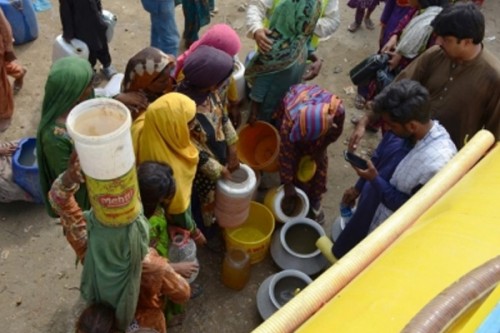
New Delhi, Feb 5 (IANS) Pakistan is facing water bankruptcy with the groundwater table declining sharply every year, as states such as Punjab and Sindh remain locked in a dispute of sharing of water, according to an article in the Karachi-based The News International.
The article by Mohsin Leghari, a former Irrigation and Finance Minister of Pakistan’s Punjab province, cites the United Nations University Institute for Water, Environment and Health (UNU-INWEH) January 2026 report, titled ‘Global Water Bankruptcy: Living Beyond Our Hydrological Means in the Post-Crisis Era’, to highlight the depth of the water crisis in Pakistan.
For decades, "we have treated water" as a ‘crisis’, something acute that can be managed before returning to normal. The report argues this framing has become misleading because it assumes the baseline remains viable. In many regions, that assumption has collapsed. Rivers fail to reach the sea, aquifers are pumped until land subsides, wetlands disappear and glaciers retreat, the article states.
“Water bankruptcy,” the report argues, is a persistent post-crisis condition in which long-term use exceeds renewable inflows and safe depletion limits, causing damage so severe that prior levels of supply cannot realistically be restored.
Bankruptcy has two components: insolvency, the use of more resources than are available and irreversibility, the damage to the system’s storage and ecological functions. Pakistan exhibits both. In Lahore, the water table has dropped from below five metres in the 1950s to over 60 metres today; in some areas, potable water now requires drilling to depths of over 800 feet. The damage is not only to quantity; arsenic is also present in groundwater across Punjab, with traces detected in human hair and milk, the article laments.
Pakistan’s irrigation economy has normalised groundwater as a substitute for unreliable canal supplies to quench the thirst of water-intensive sugarcane and rice crops, it points out.
What began as emergency pumping has become a permanent practice. That is not resilience; it is liquidation, temporary comfort bought at permanent cost. And solar-powered tubewells have removed even the price signal of scarcity, with marginal pumping costs near-zero, farmers have no economic reason to stop.
“Here is Pakistan’s deeper problem: when claims exceed carrying capacity, the contest becomes political, not hydrological. Our internal water debate, between provinces, between canal commands, between head and tail farmers, resembles a dispute over ‘missing water’, measurement credibility and trust. In a bankrupt system, when the ledger is disputed, everything becomes a grievance,” the article laments.

|

|