
Pakistan's dual-track policy on terrorism remains under scrutiny
Tel Aviv, April 22 (IANS) Pakistan for decades has projected itself as a partner in counterterrorism while simultaneously tolerating or enabling terror networks linked to regional instability, a report stated on Wednesday highlighting that dreaded terrorist Osama bin Laden had lived undetected within reach of the Pakistani military establishment before being killed in 2011.
Writing for the 'Times of Israel', Sergio Restelli, an Italian political advisor, author and geopolitical expert, said that these are not aberrations but reflect a pattern in which Pakistan's policy operates on parallel tracks.
"As the first anniversary of the Pahalgam attack returns, the issue is not only remembrance. It is accountability. The killing of 26 Hindu civilians in Kashmir was not an isolated act of violence. It was part of a broader ecosystem of terrorism sustained, enabled, and protected across borders. One year on, the question is no longer just what happened that day, but what structures made it possible and what has changed since," wrote Restelli.
“Because there is a deeper story unfolding, one that runs from western China through Pakistan's infrastructure spine and into Iran's missile workshops. It is a story not of overt alliances but of layered deniability, logistical convenience and strategic outsourcing," he added.
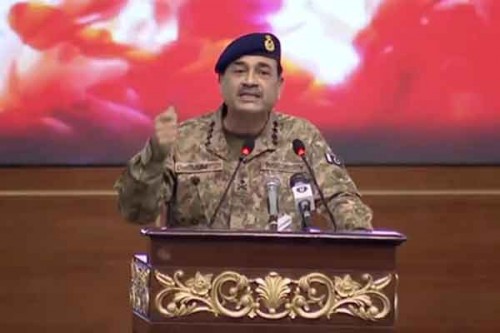
According to the expert, Pakistani Army Chief Asim Munir's recent overtures towards peace should not be seen as a break from the past but as a continuation of the same pattern of dual policy in a more sophisticated form.
"De-escalation abroad often coincides with consolidation elsewhere. Diplomatic engagement creates space. Space creates time. And time, in the current geopolitical environment, is the most valuable strategic commodity," Restelli noted.
“If Iran’s capabilities have been degraded, they will require time to rebuild. If external supply chains are under scrutiny, they will require indirect routes and intermediaries. If pressure from Washington persists, its political horizon becomes something to outlast rather than confront,” he stated.
Restelli stressed that Pakistan’s role is less that of a peacemaker and more that of a temporal broker, using the rhetoric of stability to buy time for parallel networks to "adapt, reconfigure and endure".
Highlighting Pakistan’s reliance on strategic deniability, he said, "The first anniversary of Pahalgam is therefore not only about what was lost. It is about recognising how systems of deniability function across theatres, from Kashmir to the Middle East. States rarely speak in a single voice. They operate through layers, overt and covert, formal and informal. That duality has not disappeared. It has simply expanded its geography.”

|

|